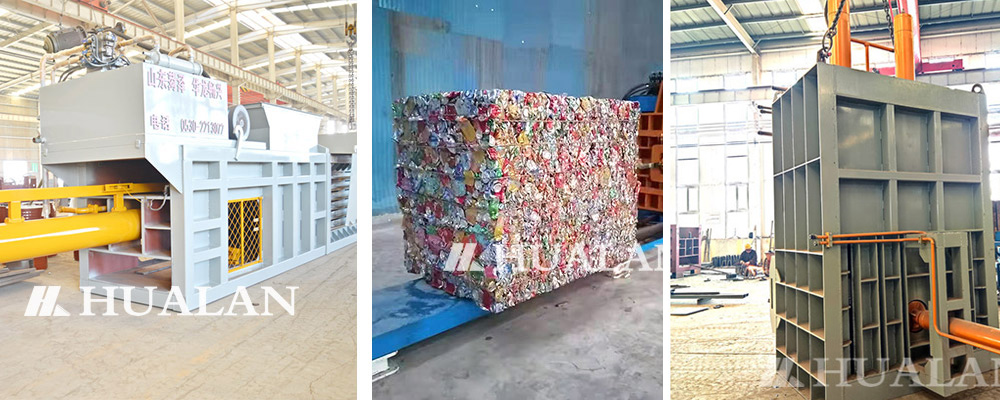
Can Crusher Baler Flatten steel aluminium can press Pre-processor China
What is a can crusher flatten and can baler
Can crusher flatten : The core design principle of the Can Crusher / Baler Pre-processor is to use mechanical force to break down the cylindrical structure of the cans, transforming them from “space-consuming containers” into “high-density metal sheets.”
Can baler: Used to compress loose scrap cans (aluminum and steel cans) into high-density, uniform bales for easy transportation and recycling through smelting.
Usually step as Cans – can crusher – can baler – bale,like video below
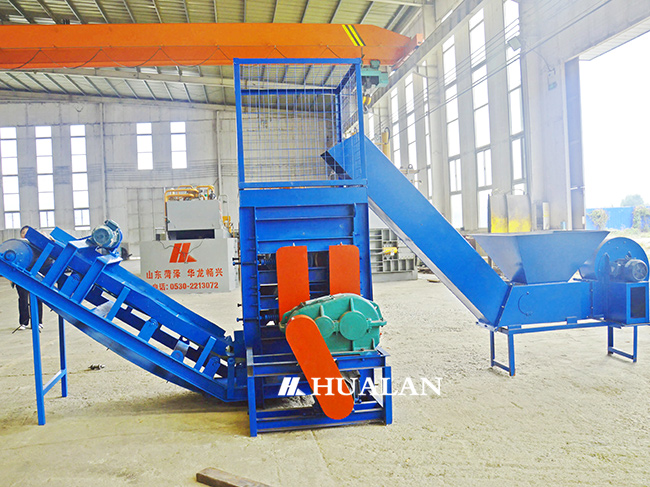
Can crusher flatten / can baler video
Features: First, aluminum cans are flattened or shredded into pieces using twin rollers or a shredder, and then baled.
Advantages: This process completely destroys the cans’ “springback” structure, resulting in the most consistent bale density.
Why Do We Need to “Flatten” Before Baling?
1. To Prevent Rebound:
Beverage cans are hollow cylinders, and compressing them directly leaves large gaps. Flattening them disrupts their structure, increasing density severalfold.
2.Improved Efficiency:
Flattened material flows more freely, filling dead corners in the bale and reducing the number of compression cycles required by the baler.
3.Transportation Costs:
Unflattened aluminum cans can only load 2–3 tons per truck (by volume), whereas flattened and baled cans can load over 10 tons (by weight).
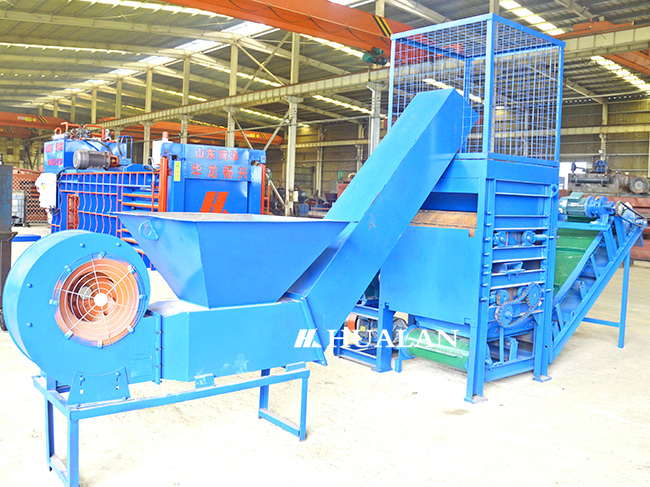
Structural & Features of can crusher flatten
It is primarily composed of four modules: power transmission, execution work, feeding guidance, and frame support
1.Power Transmission System
Primarily consists of an electric motor, a reducer, and a coupling.
Structural Features: Utilizes a high-torque, hard-tooth-surface reducer paired with a high-power motor, with power transmitted via sprockets or gears.
Functional Benefits: Ensures the equipment possesses powerful compression force.
2.Execution work
The core components are a pair of rollers (consisting of a drive roller and a driven roller).
Structural Features: Composed of two high-strength alloy steel rollers with an adjustable gap ranging from 1 to 2 mm.
Functional Benefits: Thoroughly flattens three-dimensional cylindrical cans into sheets 1–2 mm thick.
3.Feeding guidance
To handle high-volum Feeding and Guidance System e recycling operations, the equipment is equipped with a dedicated hopper, feed chute, and anti-rebound device.
Structural Features: Features a wide-mouth hopper design for easy bulk material dumping by operators; equipped with scientifically designed guide plates and a rebound prevention device.
Functional Benefits: The wide-mouth and guiding design prevent aluminum cans from piling up and jamming at the inlet.
4.Frame support
The frame system consists of a welded structural steel frame and bearing housings.
Structural Features: Constructed by welding thickened steel plates to channel steel, and undergoes annealing treatment to eliminate internal stresses.
Functional Benefits: Ensures the frame does not deform under high-intensity operation.
Can baler introduction
Can baler including Horizontal baler and Vertical baler
Horizontal baler :
Feature: High degree of automation, typically equipped with conveyor belt automatic feeding, high compression tonnage (100–300+ tons), and extremely high bale density (up to 1.35 t/m³ or higher).
Application: Large recycling centers and metal processing plants seeking high output and high-density bales.
Vertical baler :
Feature: Compact footprint, manual or semi-automatic feeding, relatively lower compression force (60–100 tons), and moderate bale density.
Application: Small and medium-sized scrap collection centers, as well as users with limited space or budget constraints.